

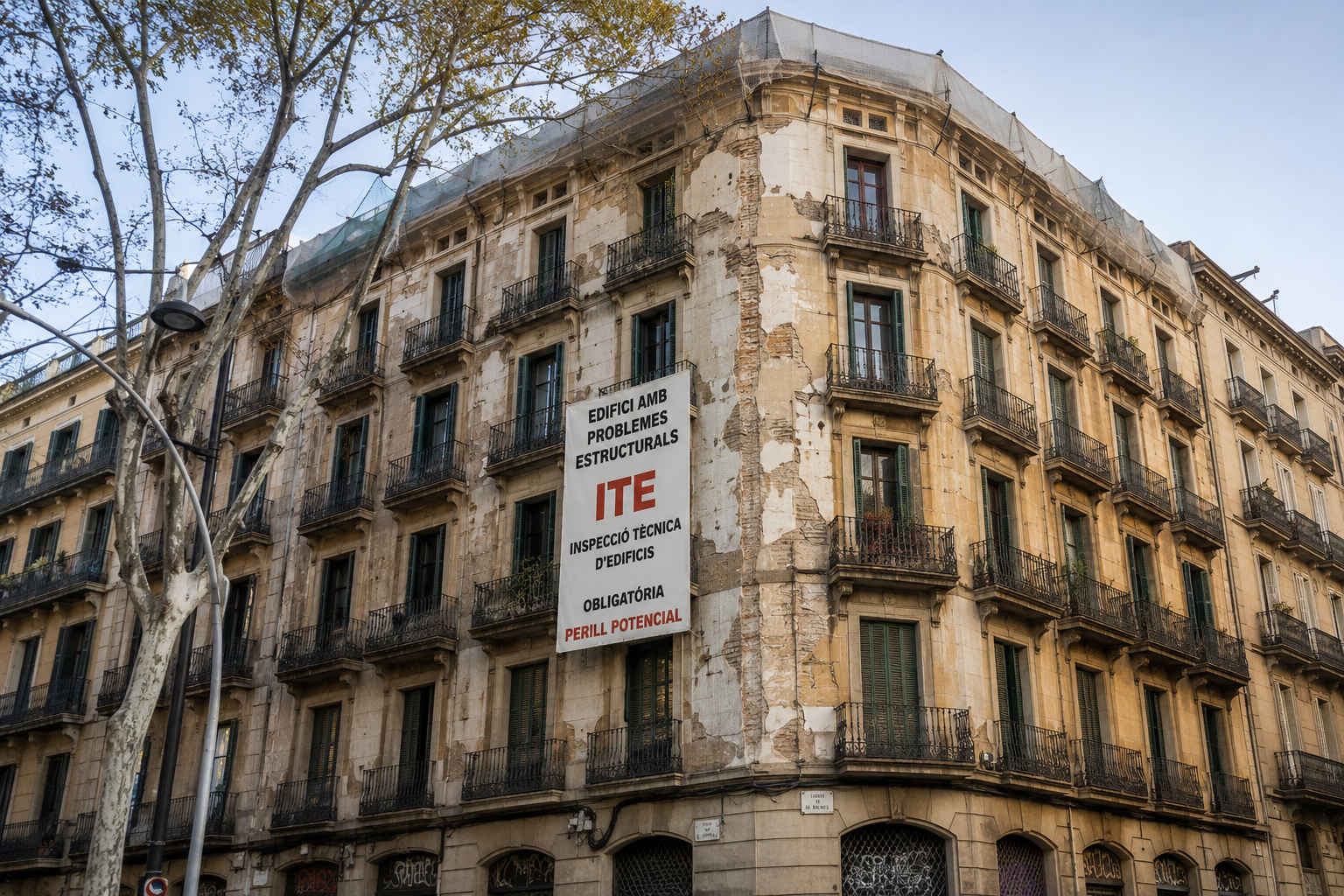
If you are a property owner or member of a residents' community in Barcelona, the Maresme or the Costa Brava, there is a figure that should give you pause: almost half of all buildings that undergo the Technical Building Inspection (ITE) in Catalonia do not pass with flying colours. Not because the standards are particularly demanding, but because the actual condition of many properties leaves a great deal to be desired.
What do the figures tell us about the ITE in Catalonia?
According to the latest annual report by the Sindicatura de Greuges de Catalunya, during 2024 just over 11,300 ITE applications were processed by the Agència de l'Habitatge de Catalunya. Of these, slightly more than half — around 53% — received a certificate of suitability with no deficiencies or only minor ones. The remaining approximately 47% received certificates of «provisionally suitable», «conditionally suitable» or outright «unsuitable». This translates to roughly 5,300 buildings with significant or serious problems that require remedial works.
In practical terms, this means that almost one in every two inspected buildings has some form of deficiency that may put the safety of its residents or third parties at risk.
What is the difference between «provisionally suitable» and «unsuitable»?
Not every situation carries the same degree of urgency, but none should be ignored. In broad terms, the certificates are classified as follows:
- Suitable with no deficiencies or minor deficiencies: the building is in good condition or has minor faults that do not compromise safety.
- Provisionally suitable: serious deficiencies have been identified, but the community has already taken urgent measures to eliminate the immediate risk. A deadline is granted to carry out the definitive works.
- Conditionally suitable: a similar situation, but with specific nuances regarding the measures taken or the deadline granted.
- Unsuitable: the building presents serious or very serious deficiencies and sufficient measures have not been taken. This is the most concerning classification and requires immediate action.
In all cases other than «suitable with no deficiencies», the owners' community has a legal responsibility to carry out the necessary works within the deadline set by the resolution.
What are the most common deficiencies?
Our accumulated experience managing communities in areas such as Mataró, El Masnou, Blanes and the neighbourhoods of Barcelona city shows that the most frequent problems tend to be:
- Façades with falling masonry or structural cracks.
- Roofs in poor condition causing water ingress.
- Outdated plumbing or electrical installations that no longer meet current regulations.
- Recurring damp problems in common areas and basements.
- Staircases or common elements posing a risk of falls.
Many of these situations worsen precisely because there is no planned preventive maintenance programme in place. A well-maintained building rarely arrives at the ITE with unpleasant surprises.
What should your community do if the ITE result is unfavourable?
The first step is not to panic, but equally not to ignore the problem. A negative or provisional certificate is not the end of the process — it is the starting point for action. The usual steps are as follows:
- Call an extraordinary general meeting to inform all owners of the result and its implications.
- Obtain several quotes from specialist companies for the required works.
- Explore available grants and subsidies, as Catalonia has specific funding lines for the rehabilitation of buildings with serious deficiencies.
- Agree at the general meeting on the special levy or financing plan required.
- Carry out the works within the established deadline and obtain the definitive certificate of suitability.
The property manager plays a key role throughout this process: coordinating information, managing quotes, convening meetings and liaising with the Agència de l'Habitatge to ensure that all deadlines are met.
Preventive maintenance: the best investment
Beyond the ITE itself, the reality is that communities which carry out regular inspections of their building avoid more serious problems and, above all, avoid far higher costs in the future. A roof inspected every few years costs considerably less than an emergency repair following a water leak that has affected several properties. Prevention, ultimately, is always cheaper than the emergency fix.
At Fincas Caseuro we have been supporting owners' communities in Barcelona and its metropolitan area, the Maresme and the Costa Brava for over 30 years. If your building's ITE is coming up, has received an unfavourable rating, or you simply want to know the current condition of your property, do not hesitate to get in touch with us. We will help you manage the entire process smoothly and without complications.