

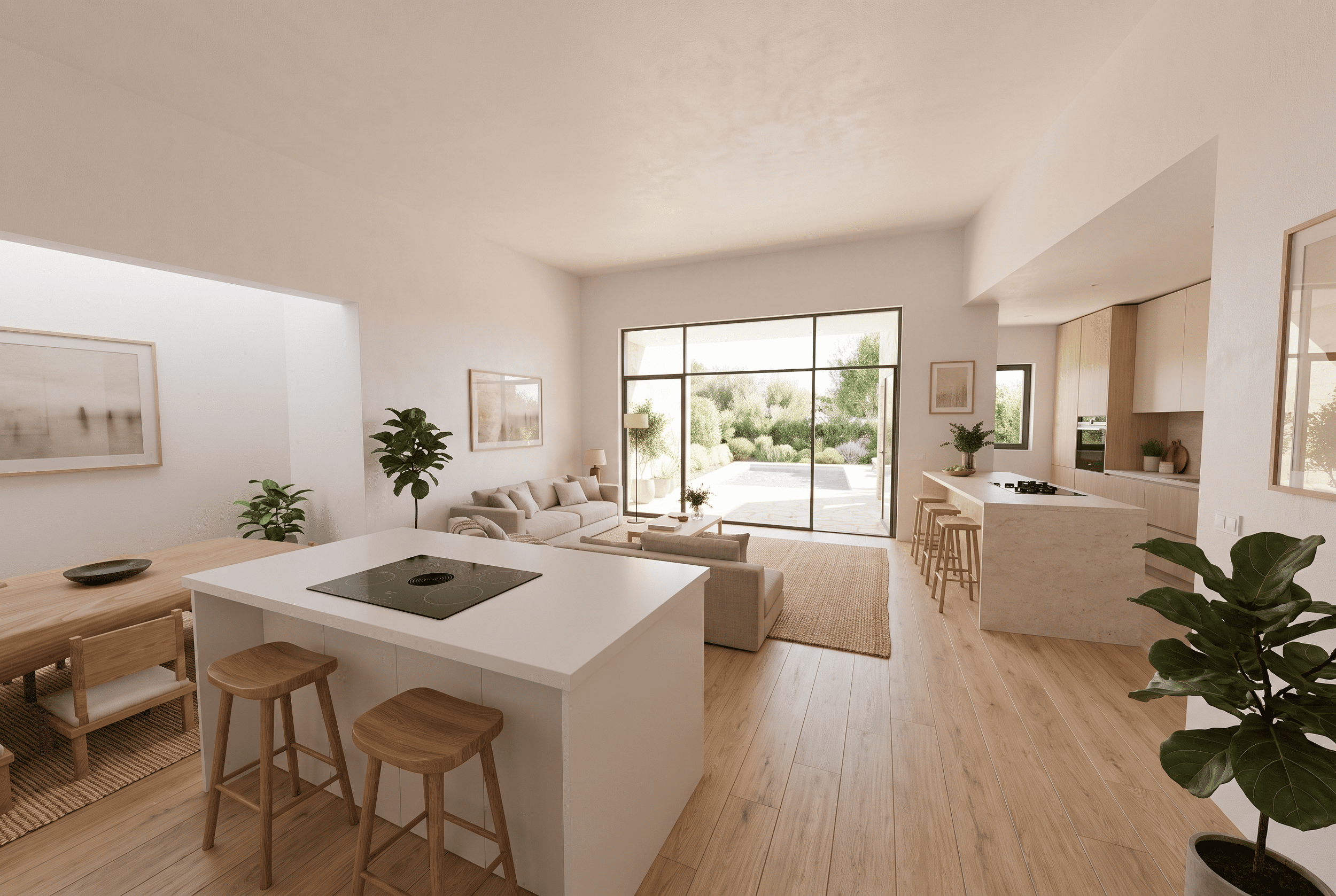
We live at a relentless pace. Work, screens, notifications… and when we finally get home, the environment often does little to help us switch off. Slow living interior design is built on a simple yet powerful idea: your home can be an active ally in slowing down, not merely a place to sleep.
This is not about following a fleeting trend or buying furniture from a particular collection. It is about approaching the space where you live with calm, intention and materials built to last. And this applies equally whether you have a flat in the Eixample, an apartment on the seafront of the Costa Brava, or a house in a residential development in the Maresme.
What exactly is slow living applied to the home?
The term comes from a broader movement that champions doing things slowly and well. Applied to interior design, it means moving away from impulse purchases, decorative objects that serve no real purpose, and spaces that are restyled every season. Instead, the focus is on pieces with a story, natural materials and atmospheres that invite you to linger.
The goal is not to have a minimalist or bare home. It is to have a home where every element is there for a reason: because you love it, because it is useful, because it holds a memory, or simply because it works well in that space.
The eight principles that define this approach to decorating
- Natural materials: wood, linen, cotton, stone, wicker. These textures convey warmth and create a visual connection with the natural world outside.
- Warm, natural light: make the most of daylight and, when using artificial lighting, choose warm tones that are easy on the eyes.
- Visual order: there is no need to get rid of everything, but reducing visual noise — scattered objects, clashing colours — goes a long way towards creating a sense of calm.
- Pieces with a story: an inherited chair, a flea-market vase, a handmade blanket. Objects with a history give a space personality and break free from the catalogue aesthetic.
- Plants and natural elements: bringing nature indoors — even a single well-placed dried branch — can transform the energy of a room.
- Neutral and earthy tones: beige, slate grey, moss green, ochre. These are shades that never tire the eye and work well at any time of day.
- Functionality above all: a beautiful object that never gets used becomes clutter. In slow decorating, beauty and practicality go hand in hand.
- Decorating without rushing: this is perhaps the most important principle of all. There is no need to furnish a home all at once. Pieces can be added gradually, allowing the space to evolve in line with how you actually live.
Why does this make such sense for homes in our area?
In many of the areas where we work — such as the towns of the Maresme (Vilassar de Mar, El Masnou, Premià de Mar) or the Costa Brava villages of Palamós and Sant Feliu de Guíxols — local architecture already lends itself to this aesthetic: homes with traditional ceramic flooring, exposed beams and large windows overlooking the sea or garden. In these cases, slow living is not an imposed style but a way of enhancing what the property already has to offer.
In Barcelona, where flats tend to be more compact, the principles of visual order and functionality become even more important. A well-organised flat decorated with intention feels larger, brighter and, above all, more liveable.
A thought for owners looking to let or sell their property
If you are considering letting or selling your flat, applying these principles can make a real difference to how a prospective tenant or buyer perceives the space. Tidy, well-lit rooms with a coherent decorative scheme make a far stronger first impression than a flat overwhelmed by furniture or overly personal, busy décor.
It need not involve significant investment: sometimes all it takes is removing what is surplus, adding a couple of plants and adjusting the lighting to make a room look considerably better in photographs and during viewings.
The home as an investment in wellbeing
Beyond trends, slow living reminds us of something we sometimes forget: a home is not merely a property asset. It is the place where you rest, eat, raise your children or work remotely. Taking care of how you feel within it is, ultimately, taking care of your quality of life.
If you have questions about preparing your property to let, putting it on the market, or simply want advice on the property market in Barcelona, the Maresme or the Costa Brava, the team at Fincas Caseuro will be delighted to help.